01 · RAG Engineering / Comparative Study

From AI-assisted prototype to evaluated RAG

A comparative engineering exercise examining what generative-AI-assisted development contributes to a functional RAG product, and what additional discipline is required to evaluate and improve reliability.

Development time
~10 h baseline / ~20 h engineered
Reference corpus
7 payslips / 5 technical PDFs
Frozen benchmark
36 INFOPAY cases / 72 AEROSPEC cases

The question

How far can AI-assisted development take a functional RAG prototype, and what engineering work is required to evaluate whether that RAG is actually reliable?

Baseline · ~10 h

Prototype 01 — INFOPAY-AI

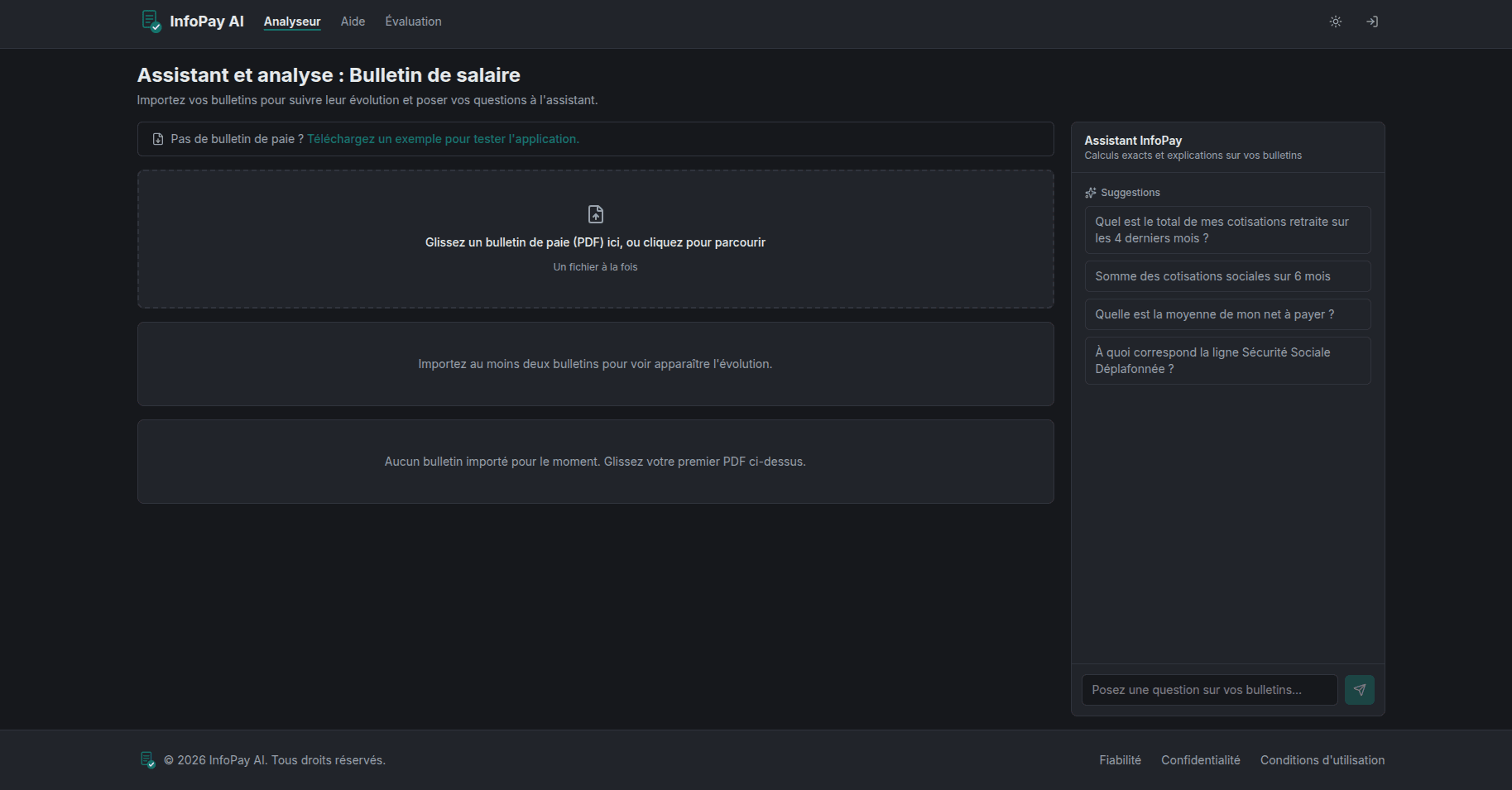
INFOPAY-AI interface

Built in approximately 10 hours, INFOPAY-AI is the rapid AI-assisted baseline. Claude Code helped produce a functional product for importing varied payslip PDFs, extracting structured salary and contribution data, visualizing multiple months and answering natural-language questions.

Its hybrid architecture routes authoritative numerical operations through Pandas. Document-oriented questions use RAG backed by ChromaDB, while LangChain and LangGraph support orchestration. This preserves natural-language interaction without asking the language model to perform authoritative calculations.

The prototype can appear satisfactory in ordinary use, but plausible answers and apparent functionality alone do not establish retrieval reliability. INFOPAY evaluation metrics are still pending.

View live project: INFOPAY-AI
INFOPAY benchmark configuration
  • all-MiniLM-L6-v2
  • ONNXMiniLM_L6_V2
  • claude-sonnet-4-6
  • langchain_anthropic
  • top_k = 3
  • distance threshold = 1.1
  • chunk_size = 800
  • overlap = 100
  • 7 PDFs
  • 7 documents
  • 13 chunks

For four fully off-topic general-knowledge questions, INFOPAY is explicitly instructed to answer from general model knowledge rather than search payslips. A 0% abstention rate for that category is intentional behavior and is not classified as a retrieval failure.

Engineered · ~20 h

Prototype 02 — AEROSPEC-AI

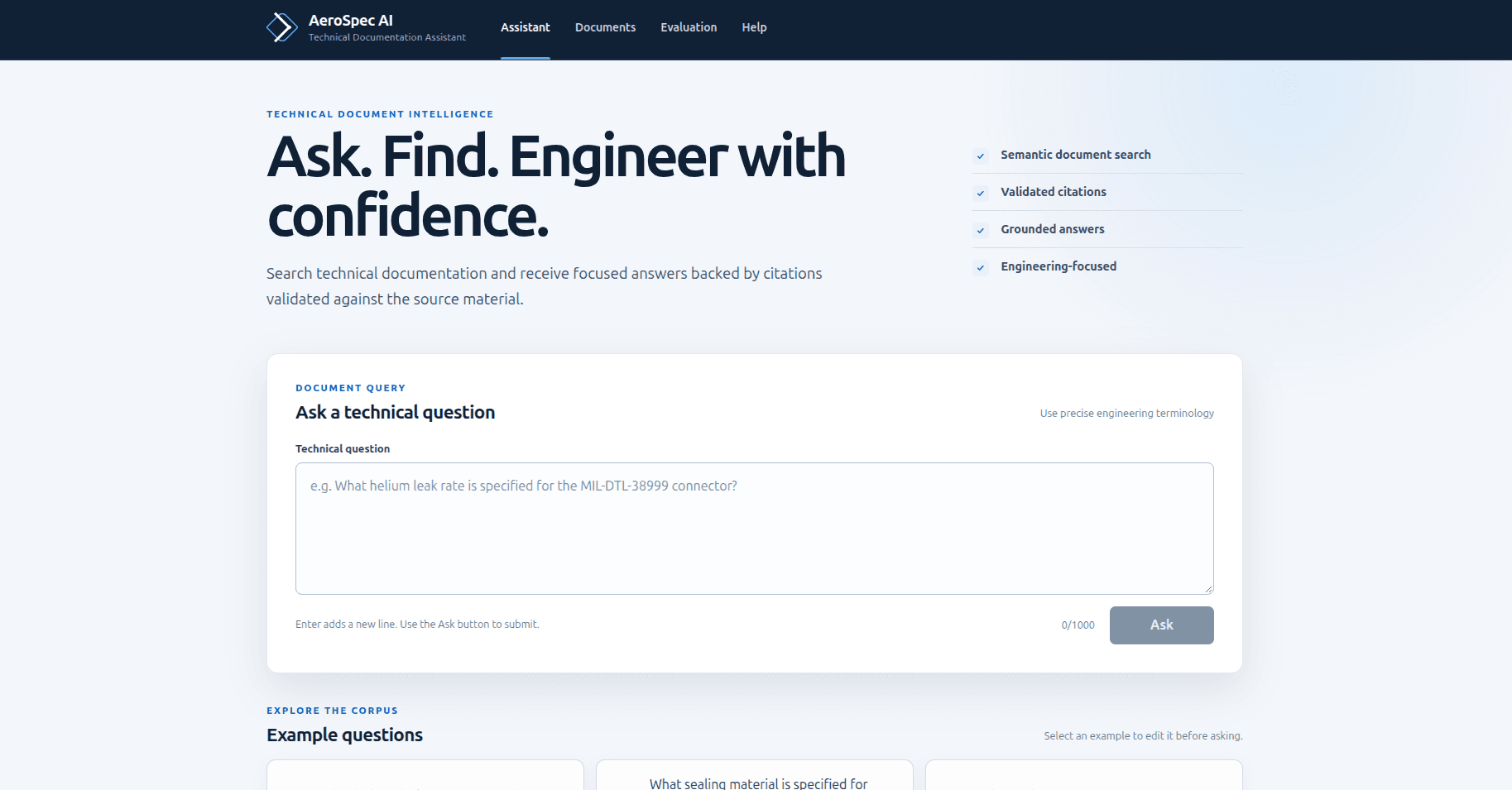
AEROSPEC-AI interface

Built in approximately 20 hours, AEROSPEC-AI works with technical documentation and focuses on measurable retrieval quality, reproducibility, source traceability, citations, abstention and error analysis.

Its explicit boundaries separate React/Vite, FastAPI, Chroma retrieval, OpenAI generation, citation validation and the JSON interface. /search exposes retrieval without generation; /ask adds generation and citations; deterministic /convert operations do not require an LLM.

Pydantic validates contracts, request IDs and structured logs support diagnostics, and sensitive question, prompt, chunk and response content is excluded from logs. Citation identifiers are validated before provenance is returned.

View live project: AEROSPEC-AI

Reference architecture

Retrieval, generation, validation, API and interface boundaries remain explicit.

  1. React / Vite
  2. FastAPI
  3. Chroma retrieval
  4. OpenAI generation
  5. Citation validation
  6. JSON response
  7. Interface

/search retrieval inspection

/ask retrieval + generation + citations

/convert deterministic operations

What changed

Rapid AI-assisted prototypeControlled engineering study
Apparent behaviorMeasured behavior
Functional RAGExplicit retrieval benchmark
Answer generationAnswer and abstention strategy
Sources availableCitation provenance validated
Manual impressionReproducible evaluation

Evaluation methodology

Two benchmarks, two descriptive results.

INFOPAY-AI was evaluated on September 24, 2026 using 36 questions: 24 answerable, 12 unanswerable and 7 fictitious payslips. AEROSPEC-AI was evaluated on September 22, 2026 using 72 questions: 48 answerable, 24 unanswerable and 5 technical PDF documents.

Source Hit asks whether the expected document was retrieved. Evidence Hit asks the stricter question: whether the retrieved chunk contains the complete evidence required to answer. Abstention measures when the system declines to answer, and citation checks validate traceable provenance.

The two prototypes were evaluated on separate benchmarks. The differences below describe their respective results and illustrate the evolution of the engineering approach; they are not an A/B experiment on an identical corpus. The benchmarks differ in size, domain and source documents, and neither measures production-wide performance.

Automatic benchmark results

INFOPAY-AI
Source Hit@333.3%
+56.3 ptsImproved
AEROSPEC-AI
Source Hit@389.6%

Correct source does not guarantee complete evidence

INFOPAY records 33.3% Source Hit@3 and 20.8% Evidence Hit@3; AEROSPEC records 89.6% and 54.2% on its own benchmark. A system may identify the correct source without retrieving the evidence needed to support the answer. AEROSPEC improves both measured rates on its benchmark, but its remaining gap still identifies retrieval precision as an area for improvement.

Abstention remains a tradeoff

The system correctly abstains on many unanswerable cases, but false abstentions remain significant. This is an area for investigation, not a solved behavior.

MetricINFOPAY-AIAEROSPEC-AIEvolution
Source Hit@125.0%87.5% +62.5 pts (Improved)
Source Hit@333.3%89.6% +56.3 pts (Improved)
Evidence Hit@112.5%35.4% +22.9 pts (Improved)
Evidence Hit@320.8%54.2% +33.4 pts (Improved)
Correct abstentions66.7%83.3% +16.6 pts (Improved)
False abstentions54.2%39.6% -14.6 pts (Improved)

Traceability

Not directly comparable

INFOPAY-AI

Sources are mechanically reconstructed from LangGraph ToolMessages as month/excerpt metadata. Five of 24 measured answerable cases produced at least one source, and 9/9 extracted records had non-empty fields. This does not verify semantic support for a generated claim.

Replies + source
5 / 24 · 20.8%
Well-formed sources
9 / 9 · 100%

AEROSPEC-AI

AEROSPEC emitted 37/37 valid citation IDs, resolved all 37 to source provenance and emitted no unknown IDs. This validates citation structure and provenance, not semantic claim support.

Valid IDs
37 / 37
Resolved
37 / 37
Unknown IDs
0 / 37

Human evaluation

Answer correctness, grounding, coverage and support are not applicable for either current benchmark because no case-by-case human review was performed. They are not recorded as zero.

Error analysis

  1. 01The correct source is retrieved but complete evidence is missing.
  2. 02An answer is produced despite insufficient top-3 evidence.
  3. 03The system fails to abstain on an unanswerable case.

Controlled iteration

The benchmark stays fixed and one variable changes at a time. These are planned experiments; no improvement is claimed yet.

  1. 01top_k: 3 → 5
  2. 02If needed, chunk_size: 1000 → 600
  3. 03Only then, modify the generation prompt

Technical stack

Conclusion

A RAG system that works in a demo is not necessarily a reliable RAG system.

The current baseline shows why retrieval evaluation, evidence-level measurement, abstention analysis, traceability and reproducible experimentation matter. AEROSPEC-AI is not presented as fully reliable; its benchmark makes remaining weaknesses visible.